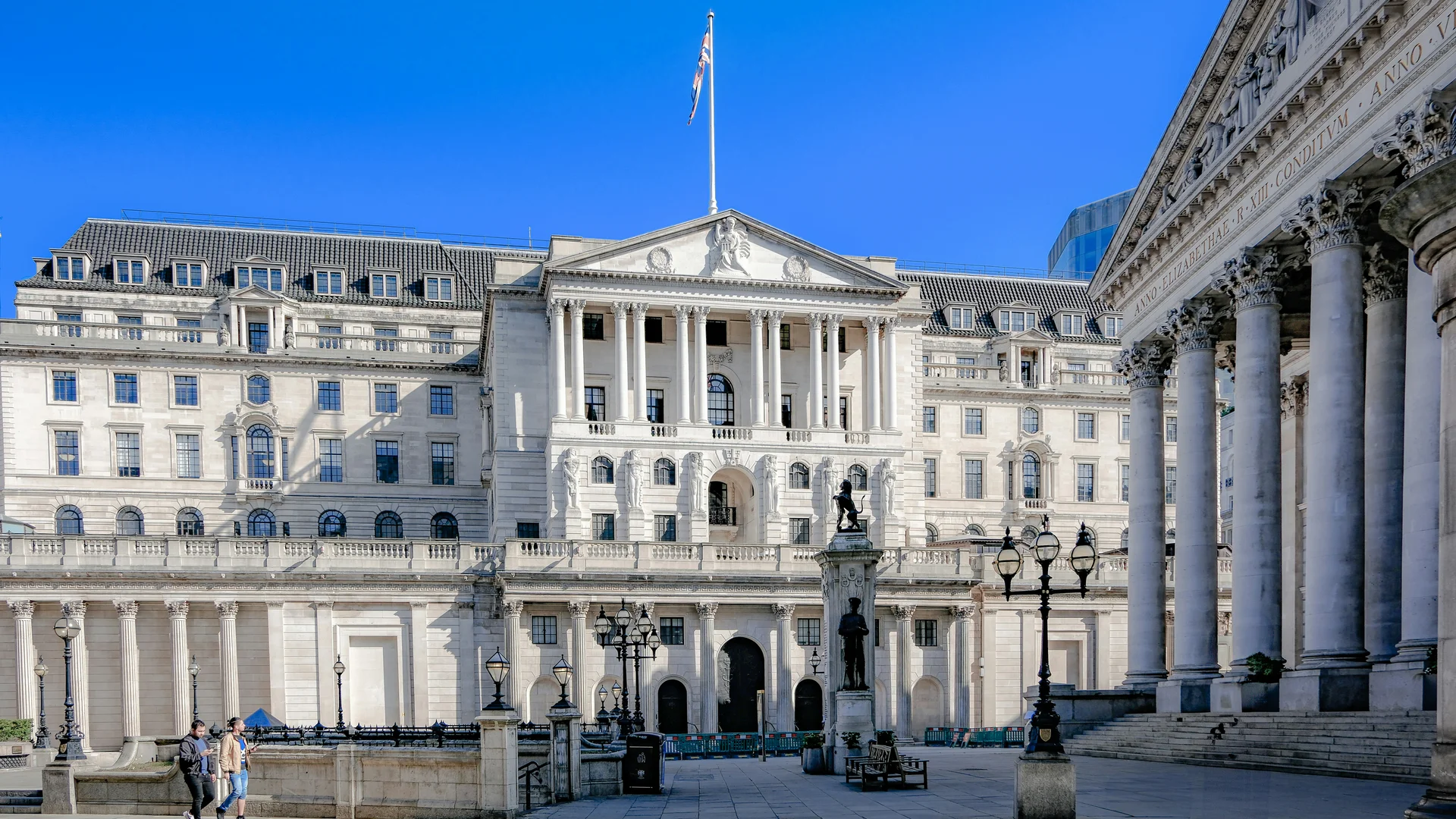
The latest Bank of England business surveys present a familiar but increasingly uncomfortable picture for the Monetary Policy Committee (MPC), with weak economic activity sitting alongside renewed upward pressure on inflation expectations. Ahead of the MPC meeting on Thursday, we take a look at what the surveys suggest for monetary policy.
The Bank of England’s April Decision Maker Panel (DMP) survey points to a clear shift in inflation dynamics following the recent energy price shock, with firms’ CPI (Consumer Price Index) inflation expectations for the next year increasing to 4% (from 3% in March). Higher inflation expectations can become self-reinforcing if firms respond by raising prices more aggressively, and this appears to be the case; businesses reported an expectation for price rises of 4.4%, suggesting rapid, but arguably realistic, reassessment of the economic consequences of the Iran war. The MPC will have already been concerned to see household inflation expectations jump in March and remain high in April, according to the Citi YouGov survey, without additional confirmation that business pricing expectations are in the same ballpark.
From the perspective of whether the price shock will lead to second-round effects, policymakers will have been somewhat happier with the survey response on pay. The DMP indicated that wage growth expectations, which will be key in the MPC’s deliberations, softened slightly, easing to 3.4%. If wage growth does not accelerate alongside inflation, demand will ultimately weaken and dampen price pressures beyond the near-term shock. The fact that the labour market has materially loosened over recent months, with marginally negative employment growth and continued contraction in vacancies, suggests firms are already cutting costs and are therefore likely to restrict wage growth.
The Bank’s April Agents’ Summary of Business Conditions reinforces this picture, describing economic activity as weak across much of the economy. Output growth remains subdued, construction and manufacturing are particularly soft, and demand for business services is being held back as firms continue to focus on cost control. Export demand, especially from the EU, also remains weak.
At the same time, the Agents’ report confirms that higher energy prices are feeding into input costs. Despite the price expectations from the DMP survey, will businesses be able to push through price increases amid weaker activity and higher unemployment? The UK is not seeing strong demand-led inflation, but rather renewed cost pressure at a time when growth is already fragile.
This creates a difficult trade-off for the MPC this week. The case for caution remains strong, but the inflation risks are becoming harder to ignore. Weak activity and softening labour market signals argue against tightening policy further now, particularly when higher rates would add pressure to households, firms and public-sector borrowers. However, rising business and household inflation expectations amid a price shock are exactly the type of development of which central banks remain exceedingly wary, particularly following the initial impact of the Ukraine war.
Financial markets appear to have drawn a line between the immediate decision and the medium-term risk. The expectation is for no change in Bank Rate this week, but market pricing has moved towards two rate rises across the June, July and September MPC meetings. That pricing reflects the view that the Bank could ultimately be forced to respond if inflation expectations continue to rise. The issue around the Strait of Hormuz and uncertainty arising from the irregular negotiating stances of the two sides in the conflict is certainly not helping.
Arlingclose’s base case is for the Bank Rate to remain at 3.75% across the year. We currently place greater weight on weak activity, softer hiring intentions and easing wage expectations than on near-term energy-driven inflation pressure. Sustained and persistent inflation normally requires either strong demand, tight labour markets or accelerating wages, but none is clearly present in the latest survey evidence.
That said, the risks around the forecast have shifted. The DMP shows that firms’ pricing expectations have moved up, and the Agents’ intelligence suggests energy costs are again becoming a live issue for businesses. If these pressures persist, firms may attempt to rebuild margins through higher prices, even in a weak economy. This stagflationary situation may eventually bleed into wage growth.
So, the most likely outcome this week is no change in Bank Rate. The MPC has enough evidence of weak activity and labour market cooling to justify waiting, especially when the inflation pressure is more cost-led than demand-led, and the markets have already essentially tightened financial conditions with any change in policy. The tone of the minutes will matter - in March, the market interpretation was immediately hawkish. We will see what stance the MPC wishes to communicate this time around to get an idea of its priorities.
29/04/2026
Related Insights
What Is the Term Premium, and Why Is It High?
What Do Shifts in the International Order Mean for Global Finance?