
As part of our credit and market intelligence, we monitor movements in financial assets. While the volatility in government bond yields has certainly been newsworthy, particularly in the UK with the upcoming Budget, considering the yield in isolation is not enough.
That is particularly true at the moment. Government borrowing costs are elevated across most developed markets, fiscal deficits are large, debt issuance is heavy, and inflation risks remain uncomfortable due to heightened energy prices. We cannot simply point to a 5% or 6% bond yield in this environment and call it evidence of fiscal stress.
So we need to take a relative view – are there signs of greater concern among investors about a particular country relative to its peers? We’ve heard a lot about the UK’s fiscal problems, but on a spreads basis, France currently looks much more concerning. But is there something else rumbling below the surface?
France is being actively repriced
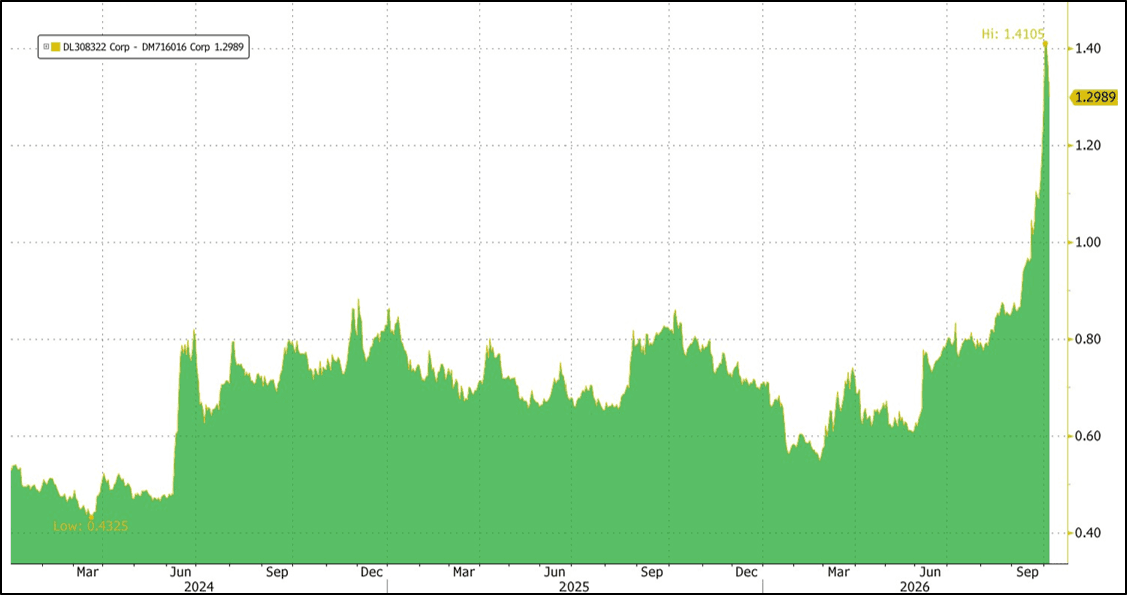
The French-German 10-year spread has become one of the clearest measures of political and fiscal discomfort in Europe. The French spread was modest for much of the post-eurozone crisis period, generally trading within 20 to 50 basis points of Germany, reflecting the market’s view that French government debt was core eurozone debt.
Recent movements suggest investors have changed their view, with the spread widening towards levels that would previously have been associated with periods of serious political or sovereign stress (this is also apparent in credit default swap spreads). Given that France and Germany share the same currency and the same monetary policy, the movement cannot be explained away through these issues.
The market is increasingly demanding compensation for the weak current and projected fiscal position. There appears to be little desire among the electorate to tackle the issue, reflected by the lack of political will from some areas to make the necessary changes.
France is still a rich economy, and comparisons with the peripheral eurozone crisis can easily be overstated. However, reducing the deficit materially will require some combination of tighter spending, higher taxation or structural reform, all of which are difficult to deliver (as we know in the UK). The current economic, inflationary and monetary environment is only exacerbating matters, especially as the European authorities show no desire to step in and support the market.
The spread suggests that investors are increasingly sceptical that France can achieve the necessary adjustments.
The UK-US spread tells a very different story
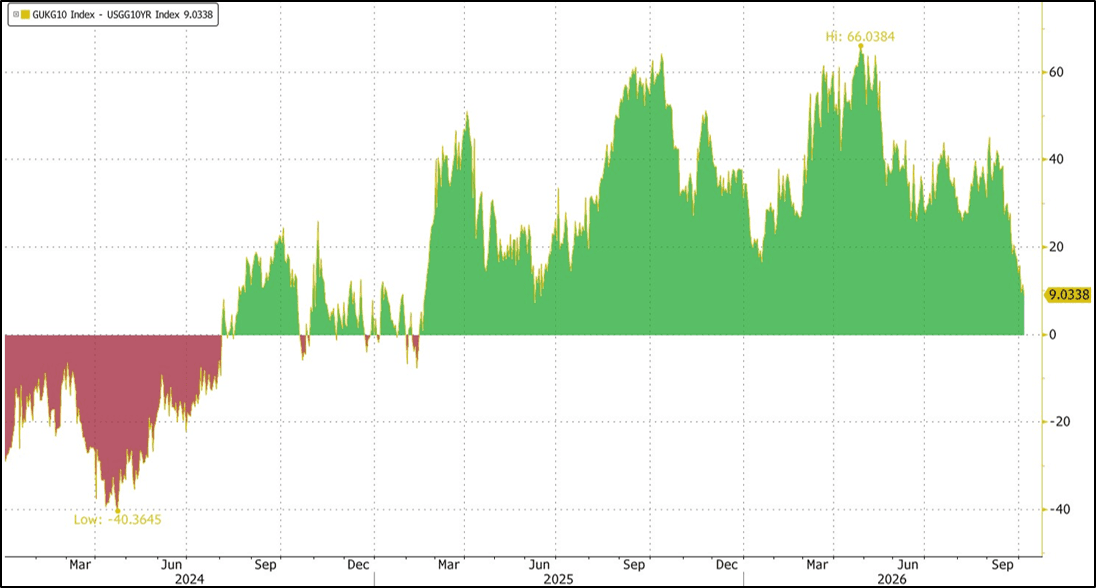
The UK has faced intense scrutiny over fiscal credibility in recent years, most obviously during the 2022 mini-Budget. At that point, gilt yields rose sharply relative to US Treasuries, and the spread clearly reflected a UK-specific risk premium. Other instances since then indicate the dim view investors appear to have of the UK’s position, which has led to politicians seemingly walking on eggshells, as they balance the country’s needs and the market’s requirements.
Today, however, the UK-US 10-year spread is relatively narrow, despite gilt yields remaining extremely high by post-GFC standards. This is quite an interesting position - if markets had become dramatically more concerned about the UK than the US, we would expect gilts to be underperforming Treasuries materially (the spread rising).
We wouldn’t say that investors are relaxed about UK fiscal policy. The UK clearly remains vulnerable; debt servicing costs are high, refinancing requirements are substantial, political decision-making is challenging around welfare and defence, and inflation is on an upward track. Investors are concerned, but we should also point out that some consolidation is already taking place (through tax rises rather than spending cuts).
The spread is perhaps telling us that some of what appears to be a UK problem is actually a much broader developed-market problem.
US Treasury yields have risen substantially as investors have reassessed the outlook for US inflation, government borrowing and debt sustainability. Fiscal deficits remain exceptionally large, Treasury issuance is heavy, and there is little obvious political appetite for meaningful consolidation. If anything, current policy is driving inflationary measures, and fiscal consolidation rests on misplaced hopes that tariffs are a silver bullet.
So the narrowing spread should not necessarily be interpreted as an improvement in UK credibility. It may simply mean that the relative position of the US has deteriorated.
What does this mean more generally?
France is experiencing a clear relative repricing, while the UK faces a somewhat different position, with high gilt yields, but a comparatively modest spread to US Treasuries. In the latter case, both markets appear to be under pressure.
That points towards a broader structural issue in developed sovereign bond markets: more debt, more issuance, less central-bank support and greater investor sensitivity to fiscal sustainability. Investors are taking a more active role, indicating that ever-growing budget deficits and rising debt ratios will be much less tolerated. Relying on prior credit history and deep, liquid markets may not be possible in the future.
What does this mean? For countries nearing or on the edge, yield volatility will be more significant. Investors are paying much closer attention to political issues that may increase fiscal uncertainty, and the shield for traditional risk-free areas appears to be fading.
For both investors and borrowers in government debt or assets linked to government debt, decision-making is more challenging, particularly on the borrower side. Planning and timing become more important, meaning a greater focus on cash flows and treasury operations – getting ahead of the game. Alternative sources of debt or hedging become increasingly necessary, as market conditions may temporarily interfere with issuance or drawdowns of traditional instruments.
Arlingclose’s role is to assist its public, private and third sector clients through all environments, helping meet challenges head-on to maintain financial credibility. Please get in touch with nkeeling@arlingclose.com for a discussion about how we can help you.


-960x640.webp&w=3840&q=75)