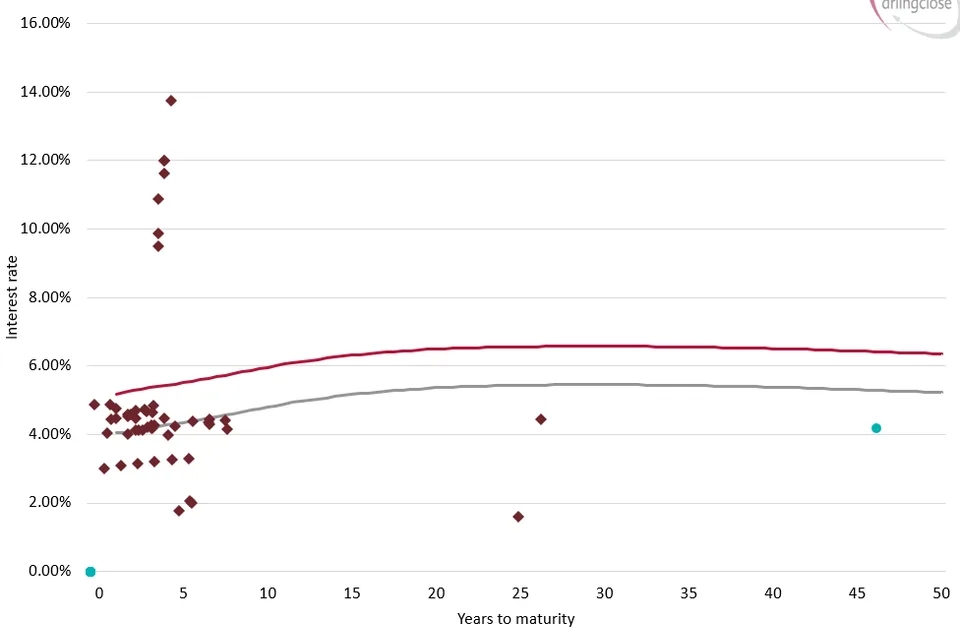
The Autumn Budget 2026 has brought several important announcements for public sector borrowing, including an increase in the Public Works Loan Board (PWLB) lending limit and an extension of the preferential borrowing rate for council housebuilding.
The Budget also introduces a £1.5 billion borrowing facility for Mayoral Strategic Authorities from April 2028, although its relationship with existing PWLB arrangements remains unclear, alongside an additional £15.4 billion of capital for the National Wealth Fund. Together, these measures signal further support for public sector investment, although questions remain over the affordability of borrowing and the longer-term outlook for public finances.
PWLB lending limit increases to £155 billion
As at 31 March 2026, the total principal outstanding on PWLB loans stood at £116.9 billion, up from £109.7 billion a year earlier. The government has announced that the statutory PWLB lending limit will increase from £135 billion to £155 billion, with provision for a further increase to £175 billion through secondary legislation.
The £20 billion increase provides additional capacity for lending to local authorities, ensuring that the PWLB can continue to meet demand for borrowing. The limit applies to total outstanding lending rather than individual authorities, meaning the announcement does not directly change how much a council can borrow.
Nevertheless, the decision is notable. With local authorities facing significant capital investment requirements, alongside the need to refinance maturing debt, the additional headroom provides reassurance that PWLB funding will remain available.
It is also worth distinguishing between the availability and affordability of borrowing. Although the increased limit provides greater lending capacity, it does nothing to reduce borrowing costs. PWLB rates remain at a fixed margin above gilt yields, which have risen considerably in recent years, placing additional pressure on capital financing budgets.
For councils considering new borrowing, the central question remains whether the financial benefits of a project justify its long-term financing costs, rather than simply whether funding is available.
Preferential HRA borrowing rate extended
The Budget also confirms a further one-year extension of the preferential PWLB borrowing rate for council housebuilding, taking the arrangement through to the end of 2027/28.
The preferential rate remains 40 basis points (0.4 percentage points) below the normal PWLB rate, providing a welcome reduction in financing costs for eligible housing expenditure.
While 40 basis points may appear relatively modest, the savings can be significant over the life of a long-term loan. For example, a £10 million maturity loan taken over 40 years at a rate 0.40 percentage points lower would generate annual interest savings of £40,000, equivalent to £1.6 million over its term.
The extension also comes with an additional £1.5 billion of government funding for the Social and Affordable Homes Programme, intended to support the delivery of around 10,000 additional homes.
However, the continued use of annual extensions introduces uncertainty for councils planning longer-term housing investment. Housing development programmes often span several years, while the associated borrowing may remain outstanding for decades.
With the preferential rate subject to ongoing review, councils will need to consider whether to take advantage of the discount while it remains available or defer borrowing until funding is required, potentially facing different interest rates and borrowing terms.
The availability of cheaper borrowing is clearly beneficial, but greater certainty over the scheme's longevity would provide additional support for long-term HRA business planning.
Extra Funding for the NWF
The Budget also provides an additional £15.4 billion of capital for the National Wealth Fund (NWF), increasing its total funding capacity from £27.8 billion to £43.2 billion. This includes £2 billion for a new Energy Wealth Fund, supporting investment in renewable and low-carbon energy infrastructure.
The additional funding will enable the NWF to increase its investment and lending activities, including support for major infrastructure projects and regional economic development. For local authorities and combined authorities, this could provide further opportunities to access alternative financing and attract private investment into capital projects.
What does this mean for local authority borrowing?
Overall, the announcements reinforce the PWLB's central role in financing local authority capital expenditure. The increased lending limit ensures sufficient capacity remains available to meet future borrowing requirements, while the HRA extension provides targeted support for investment in council housing.
However, neither announcement changes the wider challenges facing local authority treasury management. Borrowing costs remain elevated, and councils must continue to balance their capital investment ambitions against the financial pressures associated with servicing long-term debt.
For treasury management teams, the underlying considerations remain unchanged. Borrowing decisions must account for prevailing interest rates, refinancing risks, debt affordability and the longer-term financial implications of capital investment.
The Budget provides additional flexibility and support, but it does not remove the need for careful borrowing strategies. With financing costs remaining elevated, the challenge for local authorities is not simply securing access to borrowing but ensuring that the debt taken on today remains affordable well into the future.
If you require support with your authority's borrowing strategy, including debt affordability assessments, borrowing options or the timing of new borrowing, please contact the Arlingclose team at treasury@arlingclose.com to discuss how we can assist.