
Transnational education (TNE) has become a core component of many UK universities’ international strategies. Student numbers studying UK degrees overseas are now approaching those of international students studying in the UK, with over 650,000 TNE students compared to around 700,000 international students onshore. Growth also continues to outpace onshore recruitment.
While much of the sector commentary has focused on scale and strategic reach, less attention has been given to a more immediate consequence of this shift: the impact on foreign exchange exposure and international payment structures.
As universities expand offshore delivery, they are exposed to a more complex, and in many cases riskier, financial operating model.
Structural Changes
The traditional international student model is relatively straightforward from a treasury perspective. Tuition fees are typically paid in sterling, or converted at the point of payment, with limited residual foreign exchange exposure for the institution. TNE alters this position fundamentally.
Income is increasingly generated in local currencies and received through a range of structures, including franchise fees, royalties, and revenue-sharing arrangements. Cash may be retained offshore, partially repatriated, or offset against local costs.
The result is a shift from a largely sterling-based income stream to one that is multi-currency, geographically dispersed, and operationally dependent on third parties. Foreign exchange risk is now embedded within core income streams and must be actively managed.
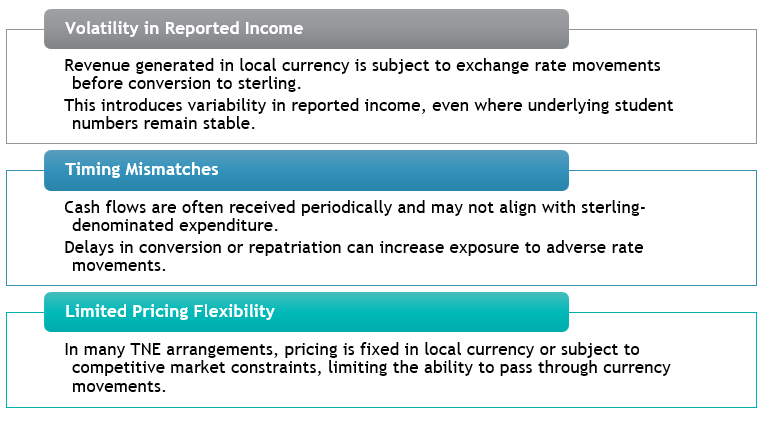
In practice, this shift gives rise to a number of recurring foreign exchange challenges:
Repatriation and Convertibility Constraints
In certain jurisdictions, the movement of funds is not frictionless, and this presents a distinct challenge for universities operating TNE models. Currency controls can restrict or delay the transfer of funds out of a country, while local regulatory requirements may impose administrative burdens that slow down repatriation processes.
In addition, the efficiency and capability of local banking infrastructure can vary, introducing further delays and additional costs to international transfers. Taken together, these factors create uncertainty in both the sterling value ultimately received and the timing of cash availability, which is often the more critical consideration for treasury management.
Counterparty and Payment Structure Risk
TNE arrangements inherently involve exposure to counterparties, typically overseas education providers, and this introduces both financial and structural risk. The financial resilience and operational capability of partners directly affect the reliability of payments, with weaker counterparties increasing the likelihood of delayed or reduced remittances.
Implications for Treasury Management
The growth of TNE requires a corresponding evolution in treasury practices. Universities will need to enhance both their policies and monitoring of multi-currency exposures, assess opportunities for natural hedging where offshore income can be matched against local costs, and consider the use of hedging strategies where these are appropriate and proportionate to the scale of the risk.
This also calls for stronger alignment between finance, treasury, and international operations, so that the financial implications of offshore activity are understood and managed on a coordinated basis. Crucially, TNE activity should be fully integrated into treasury frameworks rather than treated as a peripheral or operationally separate income stream.
Arlingclose FX Management
The expansion of TNE is structural and is likely to continue as universities seek to diversify income and manage recruitment volatility. As this growth reshapes the financial profile of the sector, foreign exchange and international payment risk are becoming more central to treasury management, rather than sitting at the margins. Arlingclose can support universities in responding to this shift by helping develop and implement appropriate treasury and foreign exchange policies, identify and monitor multi-currency exposures, assess the cash flow implications of offshore delivery models, and strengthen treasury oversight of increasingly complex international payment arrangements.
We can also help institutions review the appropriateness of their existing treasury framework, consider potential hedging or natural offset opportunities, and ensure that the financial risks arising from TNE are properly understood alongside the strategic benefits. For universities seeking to grow internationally in a controlled and sustainable way, this means bringing greater clarity, discipline, and resilience to an area of risk that will only increase in importance.
If you would like to learn more about how Arlingclose can help, please contact sjones@arlingclose.com.
14/04/2026
Related Insights
What Are the Benefits of Sustainability-Linked RCFs for Universities?
-960x640.webp&w=3840&q=75)