
The Charity Commission’s guidance is clear that trustees have a collective responsibility for their charity’s financial management; a duty that sits with the whole board, not just the treasurer or finance director. This includes ensuring that investment decisions are made prudently, that borrowing is appropriate and affordable, and that the treasury function operates within a well-defined policy framework. The Commission’s position is not that trustees need to be financial experts, but that they should understand enough to provide meaningful oversight.
In practical terms, this means that every trustee who approves an investment policy, endorses a borrowing strategy, or reviews treasury performance is exercising a governance function. The more confident trustees are in understanding what they are reviewing, the better placed they are to ask the right questions, identify emerging risks, and make decisions that genuinely serve the charity’s interests.
The Commission’s guidance on investing charity money (CC14), updated in August 2023, sets out the specific duties trustees must satisfy: considering suitability and diversification, taking professional advice where appropriate, and keeping investment approaches under regular review. CC14 also makes clear that all trustees, relevant staff, sub-committees, and professional advisers should be familiar with the charity’s investment policy; an expectation that points naturally towards structured, ongoing training.
The broader governance framework, including CC3 (The Essential Trustee) and the Charity Governance Code, reinforces this by emphasising the importance of informed decision-making and effective scrutiny. Treasury management is not a specialist silo to be left to one or two individuals; it is a core part of the board’s stewardship responsibility. Training helps ensure that responsibility is carried out well.
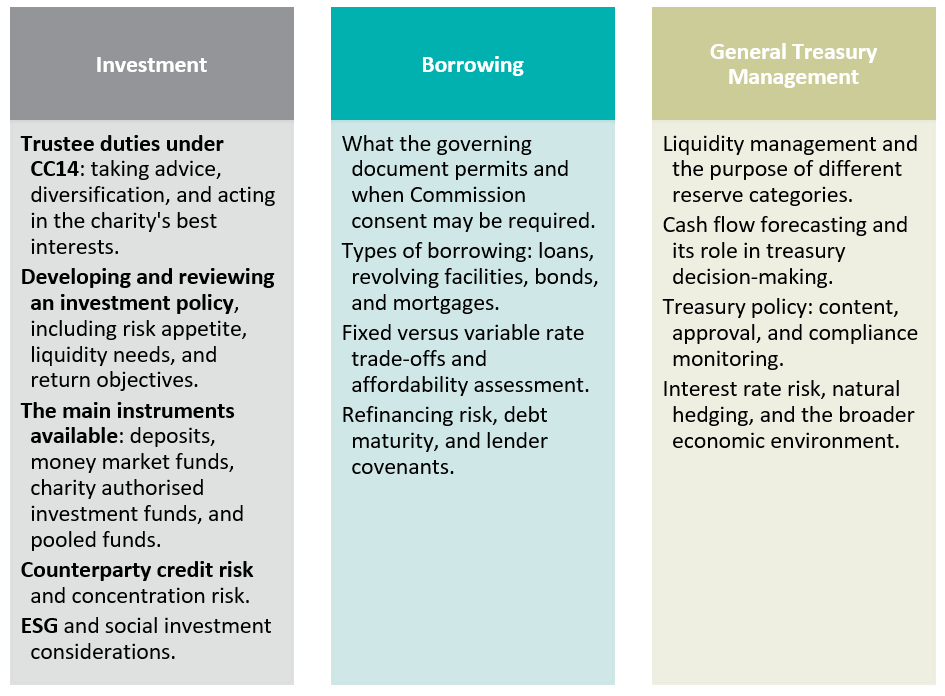
The right programme will be calibrated to the charity’s size, complexity, and activities, but a comprehensive offering would typically cover the following areas:
The benefits of treasury training are not limited to those who sit on a finance committee or manage the bank accounts. In many charitable organisations, relatively flat management structures mean that decisions with financial implications are made across a wider range of roles than would typically be the case in a large commercial business. Extending a degree of financial literacy more broadly can make a meaningful difference.
- Programme managers and project leads, for example, may have no direct involvement in investment decisions but regularly make spending commitments that affect the charity’s cash position. A basic understanding of liquidity management, that reserves serve a specific purpose, and that the timing of expenditure can matter, helps them make better decisions in their own areas of responsibility. Fundraising teams that understand how endowment or restricted funds are managed are similarly better placed to have informed conversations with donors about how their contributions are used.
- For senior staff below board level; finance managers, deputies, and heads of operations, a more detailed grounding in treasury principles builds the internal capacity to support trustees effectively. When the finance team is able to prepare clear, well-contextualised treasury reports, ask pertinent questions of external advisers, and flag potential issues early, it strengthens the overall quality of board-level decision-making. Training in this context benefits the governance structure as a whole, not just the individuals who receive it.
There is also a continuity benefit. Trustee boards turn over regularly, and the departure of a particularly knowledgeable treasurer or finance trustee can leave a noticeable gap. When treasury understanding is embedded more broadly, across staff and multiple board members rather than concentrated in one or two individuals, the charity is better placed to manage those transitions smoothly.
Arlingclose has a long-established training and advisory practice. We offer tailored training for charity trustees and staff, adaptable in depth and format to suit the audience. Introductory sessions are designed to provide trustees without a financial background with a confident grounding in the essentials. More advanced programmes can work through the full range of investment, borrowing, and risk management topics in detail, applied to the charity’s own strategy and position.
Our trustee and staff training is deliberately flexible. Sessions can be delivered as standalone workshops, as part of an ongoing advisory relationship, or as a structured annual programme. We can also prepare presentations designed to sit alongside regular finance committee or board meetings, linking the current economic environment to the charity’s specific treasury position and helping trustees understand the context behind the decisions they are being asked to make.
Training is available to both existing Arlingclose clients and non-clients. We would be happy to discuss the most appropriate format and content for your charity’s needs.
To find out more, please contact us at fwatson@arlingclose.com or visit our website.
13/04/2026
Related Insights
Are Current Market Conditions Favourable to Charity Debt Prepayment?

-960x640.webp&w=3840&q=75)