
Scottish council debt has increased markedly and moved increasingly short term over the past few years as vital services and investment continues to be funded through a difficult macro-financial environment. Taken together, they influence the risks that treasury managers need to consider.
Borrowing continues to grow
Scottish local authorities' external debt reached £25.6 billion in March 2026, with council budgets anticipating a further increase to £28.8 billion by March 2027.
There is little mystery behind the growing reliance on borrowing. Councils face significant capital investment requirements, particularly in housing and education, while inflation and tighter financial conditions have made projects more expensive to deliver. The Accounts Commission estimates that borrowing will account for around 71% of General Fund capital funding in 2026/27.
Borrowing is, of course, an appropriate way of financing long-term spending and capital needs. That said, borrowing costs ultimately place additional demands on budgets and the composition and structure of borrowing introduces unique risks.
The appeal of shorter-term borrowing
Perhaps the most striking, even if predictable, development has been the shift towards shorter borrowing maturities. Of the £5.3 billion borrowed from the PWLB during 2024/25 and 2025/26, some 68% was for terms of less than five years.
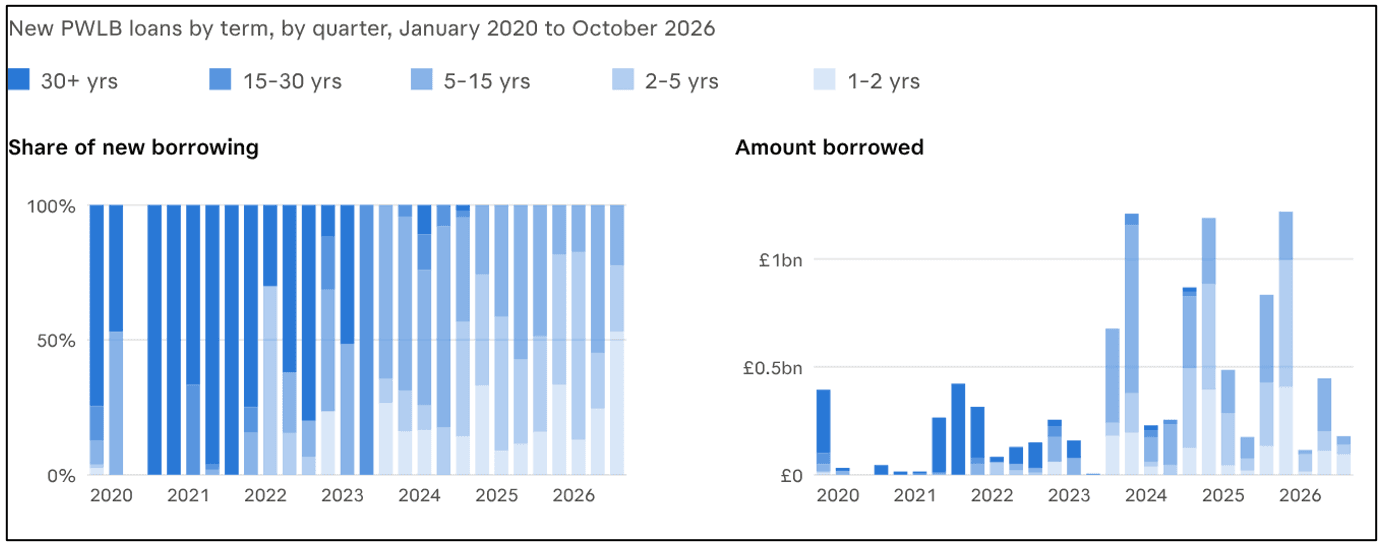
The reasoning is understandable. With longer-term PWLB rates elevated because of a steep yield curve, borrowing for shorter periods can offer meaningful savings against fixing rates for long periods. It also preserves flexibility, particularly where councils anticipate changes in their financing requirements or expect borrowing rates to fall.
Importantly, elevated longer-term rates do not simply reflect expectations that Bank Rate will remain at those levels. A substantial part reflects the term premium investors demand for holding longer-dated debt, strengthening the case for avoiding that additional cost through shorter-term borrowing. However, interest rate expectations can prove wrong, and paying a higher rate to secure longer-term certainty can be viewed as insurance against future rate rises and refinancing risk. Whether that premium is worth paying will depend on a council's debt levels, existing exposure and financial resilience.
However, the savings need to be considered against the additional exposure to refinancing risk. Shorter loans must be replaced more frequently, leaving councils exposed to the availability and price of borrowing when those loans mature.
This is especially relevant given the existing repayment schedule. At least £3.8 billion of Scottish councils' PWLB borrowing is due to mature between 2026/27 and 2028/29, including £1.45 billion in 2027/28 alone. A considerable proportion of these loans were taken out at lower rates than those currently available.
Councils face the possibility of refinancing existing debt at higher interest rates and recent shorter-term borrowing adds further repayments to the years ahead. Extending maturities would reduce that exposure, but at a significant additional cost.
Neither extreme is preferable and the optimal path for borrowing will ultimately be a balanced one considered in the broader context of the Council’s unique context.
Less cash, greater dependence on borrowing
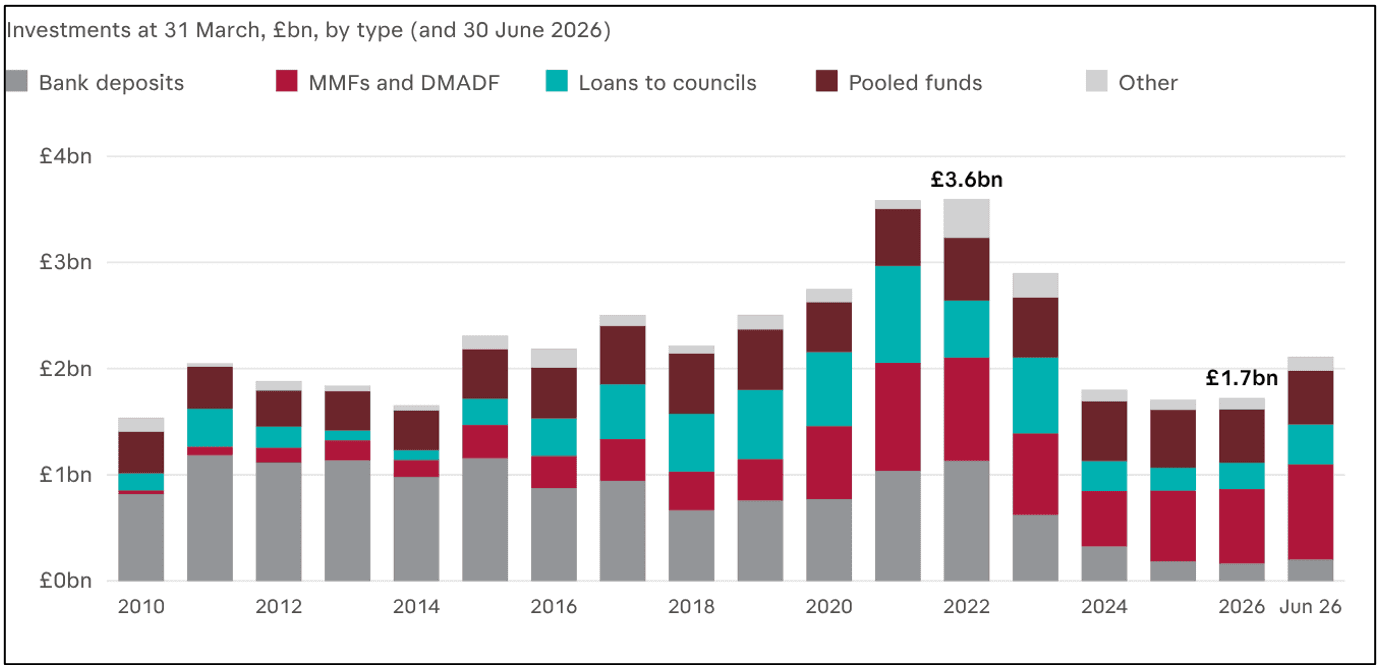
The other side of the balance sheet has been changing too as Scottish councils have seen falling cash balances.
Scottish councils held £1.7 billion of investments in March 2026, compared with £3.6 billion four years earlier. Although the pandemic temporarily inflated cash balances, the subsequent reduction means councils collectively have substantially less liquidity available than they did at their peak.
Lower investment balances are not necessarily evidence of financial weakness. Holding surplus cash while paying more to borrow can be expensive, and using existing balances to meet expenditure may be entirely sensible. Nevertheless, smaller cash buffers leave less flexibility to manage unexpected expenditure or temporary funding requirements.
This makes access to short-term borrowing particularly important. Scottish councils owed £2.2 billion to other local authorities in June 2026, demonstrating the significance of the inter-authority market as a source of finance.
That market is valuable, but its liquidity is quite seasonal. Lending availability can vary considerably throughout the financial year, particularly around year-end when authorities are managing their own cash requirements. Greater reliance on temporary borrowing, especially where maturities are concentrated around similar dates, can make refinancing more challenging.
For councils with limited cash balances, the timing of borrowing may consequently become almost as important as the rate achieved.
Looking ahead
The combination of rising debt, shorter maturities and lower investment balances does not automatically point to excessive risk. Indeed, many of the decisions behind these trends have sound financial reasoning and represent councils effectively implementing ambitious capital programmes.
What matters is whether borrowing strategies have kept pace with the changing balance sheet. With significant refinancing requirements approaching, councils will need to consider the distribution of maturities, the resilience of their cashflow forecasts and the potential cost of replacing debt under different interest rate scenarios. Paying slightly more to secure longer-term funding may sometimes represent good value, while in other circumstances retaining shorter-term flexibility will remain appropriate.
To discuss how Arlingclose could help your authority’s borrowing and liquidity position, please contact fwatson@arlingclose.com.