Performance benchmarking is the process of comparing financial, operational and strategic measures against relevant peers. At its best, it is not a league table exercise, but a structured way of asking: how are we performing, why are others different, and what can we learn?
In a period of sustained financial pressure and economic uncertainty, benchmarking has become increasingly important across both the public and wider institutional sectors. Organisations are expected to maintain resilience, deliver value for money and operate efficiently, often while managing rising costs, higher borrowing rates and increasing stakeholder scrutiny. Against this backdrop, understanding relative performance can help identify where costs, outcomes or risks may be out of line with comparable organisations.
Effective benchmarking can cover a wide range of areas. For treasury and finance teams, this may include investment returns, borrowing costs, debt maturity profiles, liquidity levels and counterparty exposure. More broadly, organisations may benchmark operational expenditure, income generation, capital delivery, staffing metrics or reserve levels. The value lies not in any single metric, but in the context around it. A higher cost base or borrowing requirement may reflect strategic investment decisions, organisational priorities or differing operating environments. Equally, it may highlight inefficiencies or emerging risks.
Benchmarking is particularly valuable because organisations rarely operate in identical circumstances. Comparing against an appropriate peer group allows finance teams and decision-makers to move beyond internal trend analysis and gain a clearer external perspective on performance. This can strengthen governance, support scrutiny and improve strategic decision-making.
However, benchmarking must be applied carefully. Poor comparator selection, inconsistent definitions or over-reliance on headline figures can lead to misleading conclusions. The purpose is not simply to identify who is performing best, but to understand what explains the variation and whether it reflects deliberate strategic choice or an area requiring further review.
For treasury teams, benchmarking can also provide assurance that strategies remain proportionate and aligned with market practice. Comparing investment diversification, liquidity levels, borrowing structures and risk exposure against peers helps organisations assess whether their treasury approach remains appropriate in changing market conditions.
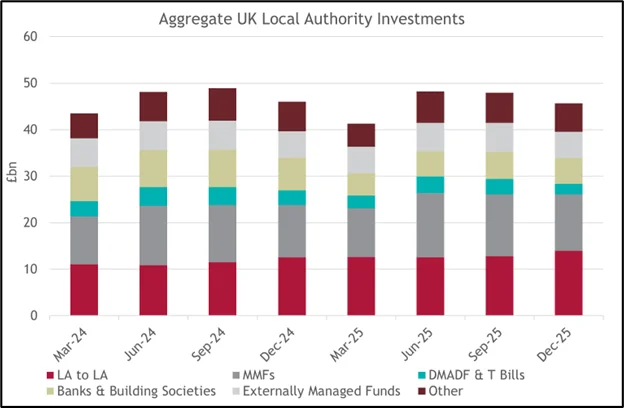
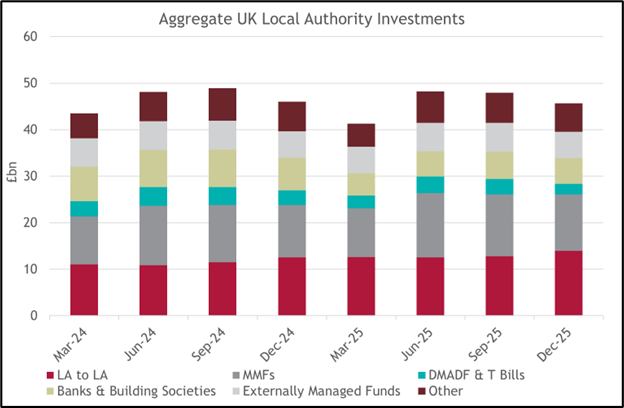
The latest MHCLG local government finance data provides a useful illustration of benchmarking in practice. The datasets bring together information on borrowing, investments, capital expenditure and revenue trends across the sector, enabling organisations to compare financial positioning and treasury activity against broader market patterns.
The aggregate investment profile of UK local authorities demonstrates how this analysis can support better decision-making. While total balances have remained broadly stable, the mix between LA-to-LA lending, MMFs, bank deposits, government instruments and other investments have shifted over time. Comparing portfolio composition against wider sector trends can help treasury teams assess whether investment strategies remain appropriately diversified, liquid and aligned with stated objectives.
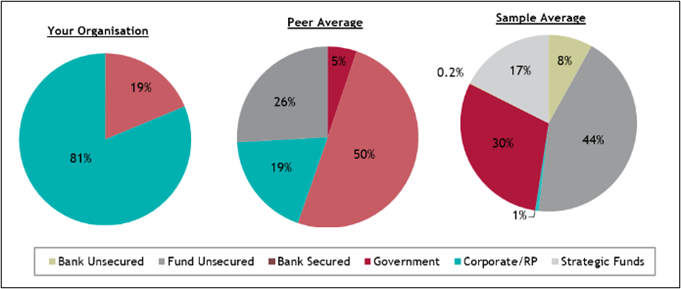
The value of benchmarking becomes even clearer when viewed at an individual portfolio level. Comparing an organisation’s investment allocation against peer averages and wider market positioning can quickly highlight concentrations, diversification trends and differences in risk appetite.
Arlingclose’s investment benchmarking service provides organisations with a detailed comparison of portfolio structure, credit quality, liquidity and investment performance against both peer groups and the wider Arlingclose benchmarking sample.
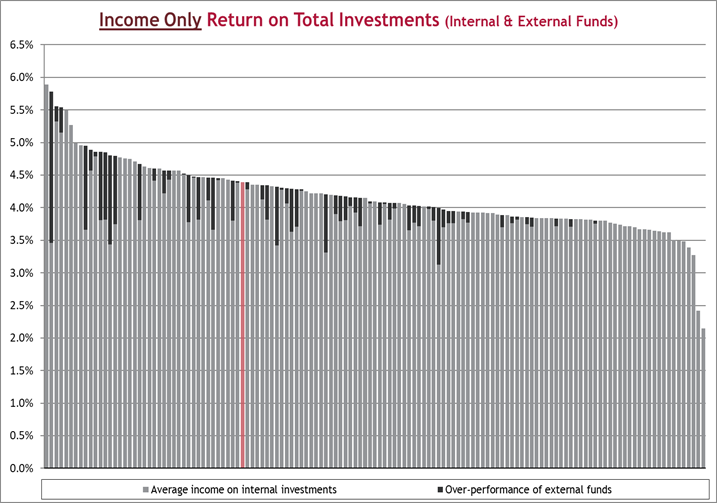
The chart below illustrates how income returns on total investments can be assessed across a broad range of organisations, highlighting relative positioning and the contribution of externally managed funds to overall performance. This type of analysis helps treasury teams understand not only whether returns are competitive, but also how portfolio structure and investment strategy may be influencing outcomes.
By placing treasury activity into a broader market context, benchmarking helps strengthen governance, support decision-making and identify opportunities for strategic improvement.
Arlingclose’s investment and debt benchmarking services are designed to support this process, helping authorities place their treasury strategies in context, strengthen governance, and identify opportunities for improvement.
To discuss how these insights could support your organisation, please get in contact at treasury@arlingclose.com.
13/05/2026
Related Insights
What is Bond Duration and Why Does it Matter?
EU Bank Failure Reform: Why Does Depositor Hierarchy Matter?

-960x640.webp&w=3840&q=75)